
Building a Robust 10-Year Maintenance Plan (MRRP) – What “Good” Looks Like
A well-prepared 10-Year Maintenance, Repair & Replacement Plan (MRRP) is the quiet engine that preserves a scheme’s value. It turns “we should fix that soon” into scheduled, budgeted work owners can see and trust. For trustees, it’s the bridge between legal compliance and practical governance: a single, living document that helps you plan ahead, avoid emergency special levies, and communicate clearly at the AGM.
Why every scheme needs an MRRP
Sectional Title life is cyclical: roofs need coatings, façades need waterproofing, gates and pumps need servicing, and paint cycles come around faster than you think. Without a plan and a reserve fund aligned to that plan, schemes drift into reactive maintenance, rising insurance risk, and unpleasant surprises. An MRRP provides:
- Visibility: what will be done, when, and what it’s likely to cost.
- Fairness: contributions matched to future needs, not guesswork.
- Stability: fewer crisis decisions, fewer special levies, better cash flow.
The legal backbone (in plain English)
- Body Corporate duties (STSMA s3): keep common property in a serviceable state.
- Owner duties (STSMA s13): keep sections (and EUAs) in good repair.
- PMR 22: the MRRP must list major capital items, their condition, timing, estimated future cost, expected remaining life, and any access/dependency factors.
- PMR 24: keep two funds—Admin (operations) and Reserve (MRRP).
- Regulation 2: minimum reserve contributions depend on your reserve level vs last year’s admin budget. These are minimum contribution rules and do not consider actual planned expenditure
- PMR 23(3): obtain a triennial replacement valuation for buildings and improvements.
What to include (beyond “paint the walls”)
A good MRRP covers building systems and envelope items you can’t afford to ignore:
- Roofs & façades (waterproofing, sealants, coatings)
- Windows, doors & balustrades
- Plumbing, stormwater & drainage
- Electrical & lighting (common areas)
- Security (gates, fencing, access control, cameras)
- Paving/roads, lifts, amenities & recreation
- Scheme-specific assets (generators, solar)
For each line item, record the condition rating, scope/timing, costs & expected life, warranties, and access needs (e.g., scaffolding).
The governance loop (make it routine)
Your MRRP isn’t a once-off file – it’s an annual governance cycle:
- Update the plan before the AGM (rebased costs, refreshed priorities).
- Approve it at the AGM (standing agenda item).
- Report annually on delivery versus plan (works completed, savings/shortfalls).
- Mandate how Reserve-fund payments are authorised for MRRP items.
How to assess your scheme like a pro
Start with drawings and PQ schedules, then do a structured walk-through:
- Use one condition scale (e.g., New → Good → Fair → Poor) to keep ratings consistent.
- Capture photos, defects and quantities—turn opinions into evidence.
- Score risk = probability x consequence to set priorities.
- Log statutory items (fire equipment services, lightning protection, OHS tasks) and warranty dates to avoid voided claims.
Priorities that protect value (and trustees)
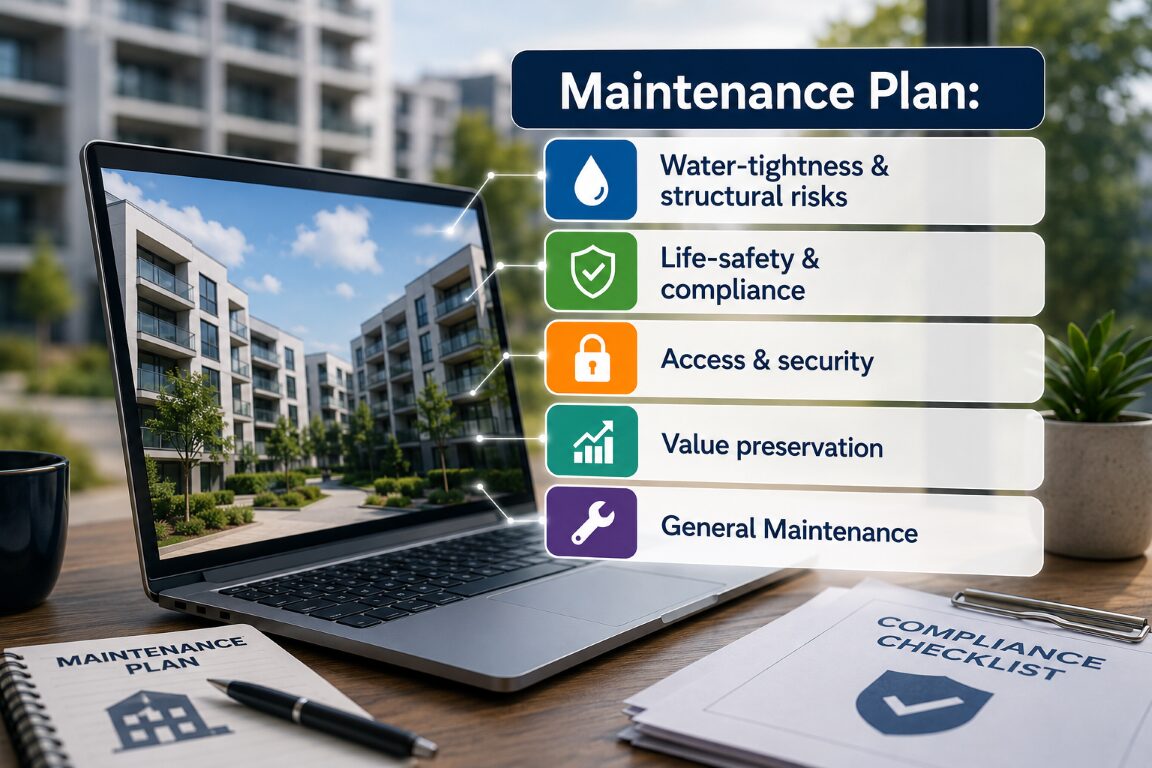
Tackle work in this order:
- Water-tightness & structural risks (roofs, façades, drainage).
- Life-safety & compliance (fire equipment, lightning protection, electrical CoC).
- Access & security (gates, fencing, lighting).
- Value preservation (painting, sealants, paving).
- General Maintenance and Nice-to-haves (only when the above are under control).
Delaying high-consequence hazards can create personal liability for trustees—your duty of care matters.
How ANGOR helps
ANGOR supports Trustees with the administrative and governance processes linked to the MRRP, including assisting with communication, reserve fund planning considerations, insurance valuation alignment, and compliant procurement processes.
While ANGOR does not inspect schemes or draft maintenance plans, we can guide Trustees on the required process and, where needed, direct them to suitably qualified professionals in the industry. Final decisions remain with the Scheme Executives.
What is the Maintenance, repair and replacement plan (10 year plan)?