
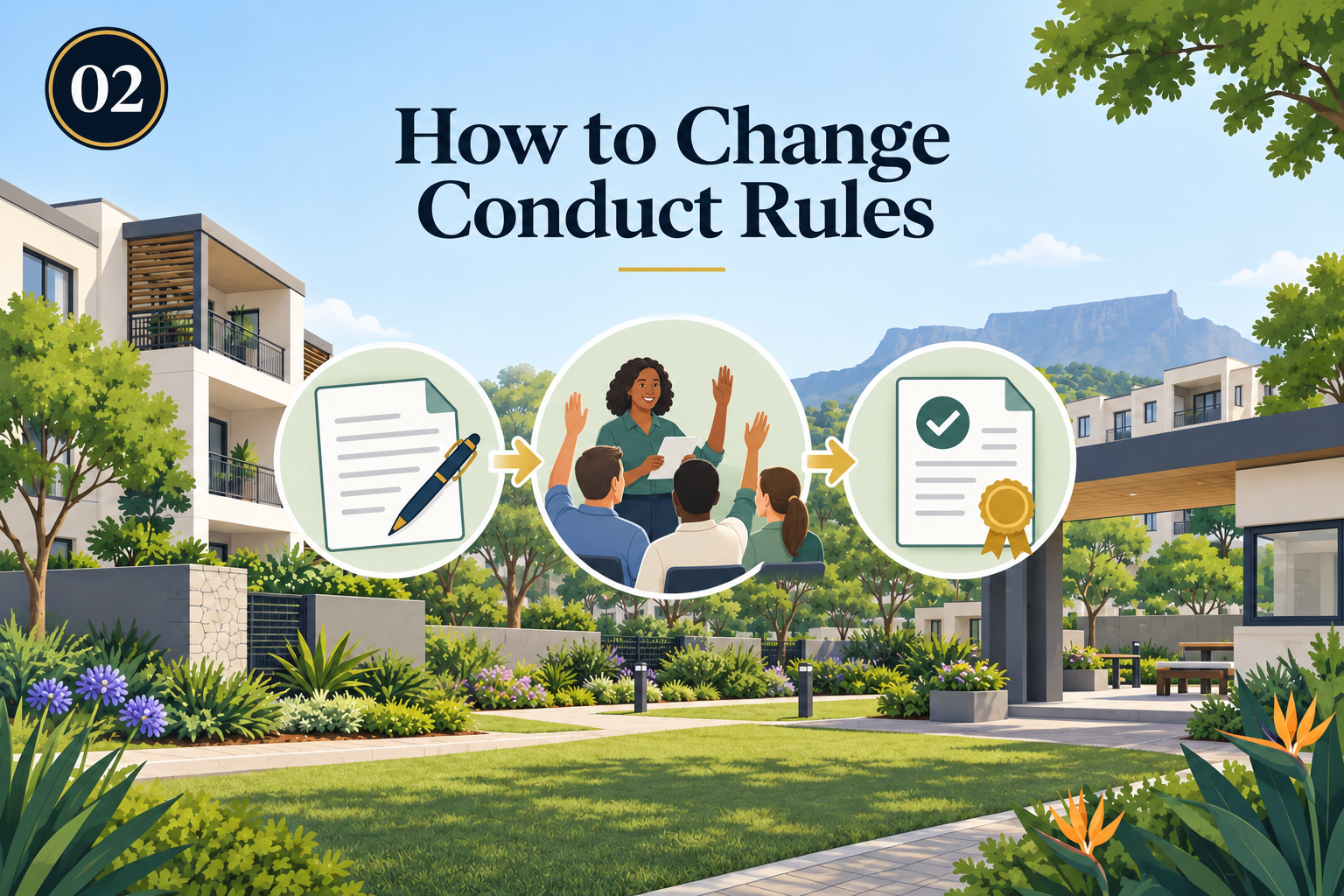
How to Change Conduct Rules – Drafting, Owner Approval, CSOS Submission, and the Section 10 Certificate
Changing conduct rules is a formal process. The key principle is simple: trustees draft, owners approve (in sectional title), and CSOS certifies.
Step-by-step: the conduct rule approval process (Sectional Title)
- Trustees draft the proposed conduct rules
- Draft rules are circulated to owners for comment and feedback
- An SGM is called for approval
- Owners approve via special resolution
- Trustees submit the rules to CSOS for review
- CSOS issues a Section 10 Certificate (rules become enforceable only then)
What needs to be submitted to CSOS?
A compliant submission includes:
- Form B (Sectional Title) / Form B1 (HOA)
- the full set of proposed rules
- SGM notice and minutes
- the resolution
- quorum calculation / proof of quorum
If CSOS tells us to change wording, do we need another SGM?
Usually no. If CSOS issues directed amendments (wording changes / removal of undesirable clauses), those changes can be made and resubmitted without going back to owners for another meeting, because it is a directive from CSOS.
What does the Section 10 Certificate actually mean?
It is CSOS confirmation that:
- the rules align with their Practice Directive
- nothing is unconstitutional or unlawful
- scheme-specific rules are now valid and enforceable
Without this certificate, rules are wholly unenforceable as scheme-specific conduct rules.