
Understanding Your Scheme’s Insurance – What the Body Corporate or HOA policy actually covers
💡 Why You Need to Know
If you live in a sectional title complex or a homeowners association (HOA), your community has an insurance policy, but it might not cover what you think it does. Many owners assume that because they pay levies, the insurance automatically protects everything, including the inside of their unit, their TV, or their car. Unfortunately, that’s not the case. Understanding how community living insurance works can help you avoid costly surprises and make sure your own home and belongings are fully protected.
🧩 What Community Living Insurance Covers
The community’s insurance, arranged by the Body Corporate (for sectional title) or HOA (for freehold developments), is designed to protect the shared structures and common property that everyone uses or benefits from.
Typical areas covered include:
- The buildings and their structural components (walls, roofs, floors, ceilings, and permanent fixtures)
- Common property, such as driveways, boundary walls, swimming pools, lifts, and security systems
- Scheme assets, like gardening equipment, tools, and office furniture
- Liability cover, which protects the scheme if someone is injured or their property is damaged on the common property
- Fidelity or fraud cover, which protects scheme funds if theft or dishonesty occurs
This insurance ensures the community as a whole can recover financially after a major event — like a fire, storm, or burst geyser — without placing the full financial burden on individual owners.
🏡 The Important Difference: Sectional Title vs HOA
In a Sectional Title scheme, the Body Corporate insures the entire building structure, including the walls, ceilings, and permanent fittings of each section.
Owners, however, are still responsible for household contents — furniture, appliances, décor, electronics, and any personal possessions.
In a Homeowners Association (HOA), the insurance applies only to shared spaces and common property — not to the individual homes built on private erven.
Each homeowner must take out their own building insurance for their house and contents insurance for what’s inside it.
🧱 Improvements and Upgrades
If you’ve made upgrades — such as new flooring, built-in cupboards, or a renovated kitchen — you should notify your scheme or managing agent.
These improvements may affect the replacement value of your section and should be noted in the insurance schedule.
Failing to do so can result in being underinsured, meaning that in the event of damage, the insurer might only pay a portion of the claim.
⚠️ Common Misunderstanding
“If a roof leak damages my TV, the scheme’s insurance should cover it.”
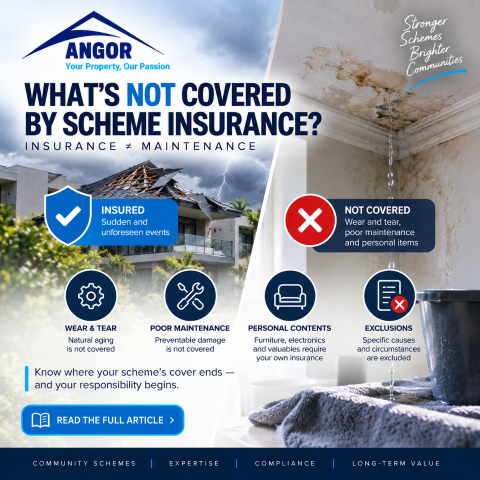
Not quite. The scheme’s insurance covers the roof and the building structure, but your TV is a movable personal item, it falls under your home contents insurance.
Similarly, the scheme’s insurance does not cover:
- Your personal belongings
- Your car (even if parked in a complex garage)
- Your pet’s vet bills
- Accidental damage caused by residents or visitors
🧭 How to Check Your Cover
- Ask your scheme executives or managing agent for a copy of the current insurance schedule, or download it from ANOGR Online.
- Confirm which policy type your scheme uses (named perils or all-risk).
- Review the sum insured, excess amounts, and exclusions.
- Discuss any personal improvements or additional risks (like solar installations) with your managing agent or broker.
Insurance in community living is there to protect the scheme as a whole, but it does not replace the personal cover each owner may need. By understanding what the Body Corporate or HOA policy includes, what it excludes, and where your own responsibility begins, you can make better decisions and avoid unexpected costs when something goes wrong. When in doubt, ask for the insurance schedule, check your own household cover, and speak to your managing agent or broker so that your property, belongings, and improvements are properly protected.
Understanding Community Living Insurance vs Personal Insurance in a Scheme